%20Logo.png?width=100&height=100&name=brs%20(Bow%20River%20Solutions)%20Logo.png)
 By
·
3 minute read
By
·
3 minute read
Artificial Intelligence (AI) is no longer a futuristic concept—it’s a present-day force transforming industries worldwide.
From Data Solutions to Cloud Services, AI helps businesses increase efficiency, improve decision-making, and enhance customer experiences.
Many organizations experiment with AI, but only a few achieve real leadership.
AI leaders stand apart because they understand that success requires more than just technology.
It demands visionary thinking, strong Data Management, and a willingness to embrace digital change.
These leaders are creating new business models, setting industry benchmarks, and showing how AI can be used strategically to create measurable ROI.
This blog explores the key traits of AI leaders, lessons organizations can learn, and real examples from industries like Oil & Gas, Manufacturing, and Energy.
What Sets AI Leaders Apart?
AI leadership goes beyond deploying algorithms or investing in tools.
It is about embedding AI strategically across business processes.
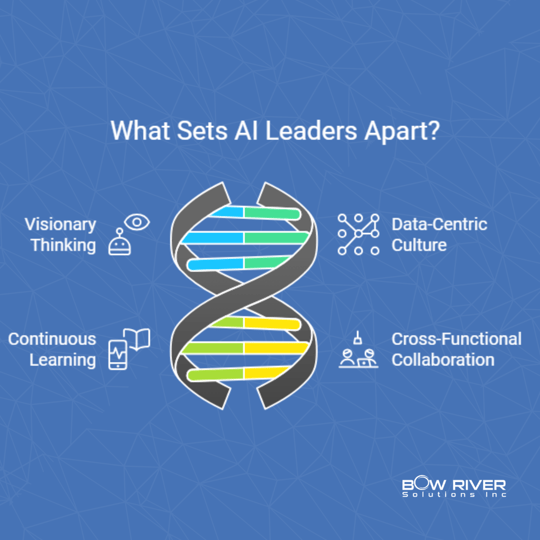
Leading organizations share several traits:
-
Visionary Thinking – AI leaders see technology as a powerful enabler.
For example, Microsoft adds AI into Microsoft Fabric through Copilot.
These solutions let companies perform business intelligence data analysis and reporting, automate tasks, and create custom software applications that improve productivity. -
Data-Centric Culture – Effective AI requires strong Data Management.
Canadian data leaders like brs (Bow River Solutions) help companies build data pipelines, improve data security, and create actionable insights.
This ensures AI models use reliable, clean, and safe data. -
Continuous Innovation – Organizations like Google DeepMind drive progress by investing in constant research.
Their work shows that innovation leads to breakthroughs that reshape industries. -
Cross-Functional Collaboration – AI leaders encourage teamwork between business units, IT, and data teams.
Amazon integrates AI across logistics, customer experience, and Cloud Services, showing how collaboration boosts value creation.
Together, these traits show that AI leadership is built on strategy, culture, and execution—not just technology.
Key Lessons from AI Leaders
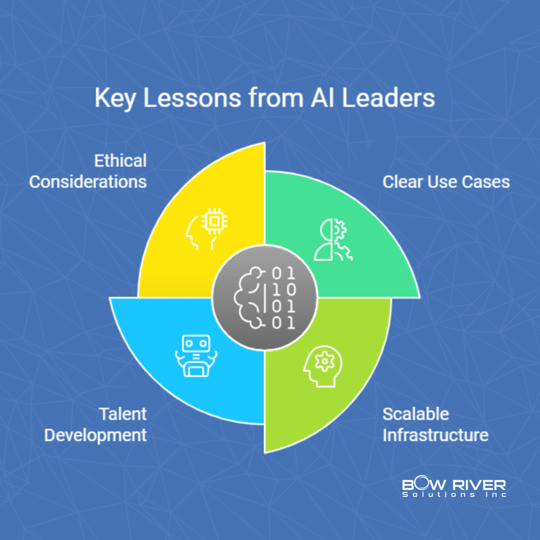
Organizations aiming to lead in AI should follow these lessons:
1. Start with Clear Use Cases
Identify specific, high-impact opportunities.
Example: Imperial Oil uses AI to analyze geological data and improve drilling efficiency.
This reduces costs and strengthens cyber safety and security protections.
2. Build Scalable Infrastructure
AI needs systems that can grow.
IBM Watson offers scalable Software Solutions for chatbots, analytics, and business intelligence applications.
3. Foster Talent and Skills Development
Invest in Data Training and offer professional development opportunities.
Companies like Meta work with universities to train AI experts.
brs supports teams through data analytics training courses and Power BI developer courses.
4. Prioritize Ethics and Transparency
AI must respect data privacy and data protection rules.
Leaders ensure compliance and maintain transparency to build trust.
Microsoft is a strong example of responsible AI by embedding fairness, accountability, and governance into its platforms.
How AI is Transforming Oil & Gas, Manufacturing, and Energy
AI in Oil & Gas – Efficiency, Safety, and Transformation
The Oil & Gas sector has always relied on data.
But AI is transforming how companies examine insights and improve operations.
-
Exploration and Drilling – Companies like Imperial Oil use AI to analyze geological models, seismic surveys, and sensor data.
AI identifies the best drilling points, reducing costs and minimizing environmental impact. -
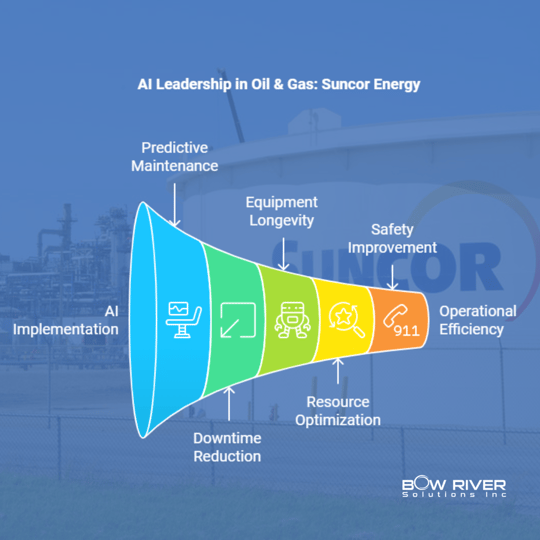
Predictive Maintenance – AI-powered tools and secure sensors monitor equipment health in real time.
Predictive models detect problems early to prevent breakdowns and accidents.
This improves safety and supports both data cyber security and network security in cyber security. -
Safety and Compliance – AI-based monitoring tools protect sensitive operational data and support privacy in cyber security.
They detect hazards earlier and help companies meet safety standards.
Canadian companies like Suncor Energy use business intelligence data analysis and reporting to reduce downtime, improve efficiency, and strengthen sustainability.
AI also helps enhance safety practices and meet network security in computer network requirements.
AI in Manufacturing – Smart Factories and Quality Control
Manufacturing is entering the era of the smart factory.
AI, automation, and IoT combine to create systems that operate faster and smarter.
-
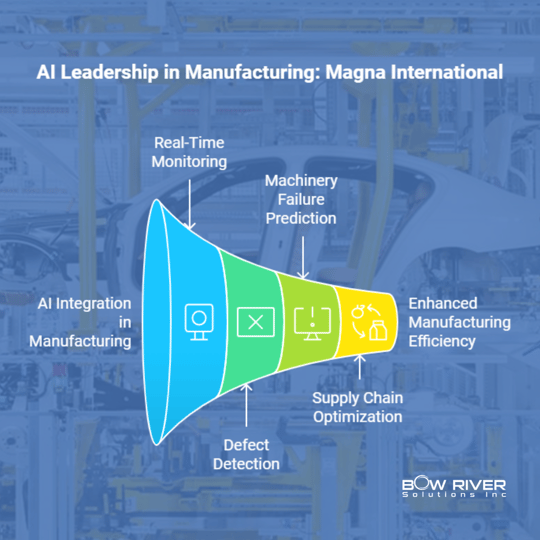
Real-Time Quality Control – Companies like Magna International use AI-powered vision tools to detect defects instantly.
This reduces waste and ensures product quality. -
Predictive Maintenance and Automation – Manufacturers also rely on AI for predictive maintenance to cut downtime.
Secure sensor networks help protect data privacy and data protection throughout operations. -
Supply Chain Optimization – AI enhances forecasting, inventory planning, and logistics.
By combining business intelligence as a service with BI tools for big data, manufacturers anticipate demand and lower operational costs.
Magna’s use of AI shows how software development custom solutions and business analytics BI help companies move quickly in dynamic markets.
Cloud Services add scalability, while Zero Trust security ensures reliability.
AI in Energy – Sustainability and Safety in a Digital Era
The Energy sector gains from AI’s ability to optimize use, improve safety, and support sustainability.
-
Grid Optimization – AI analyzes large data sets to predict demand, balance loads, and reduce energy waste.
This supports strong Data Management and cloud analytics. -
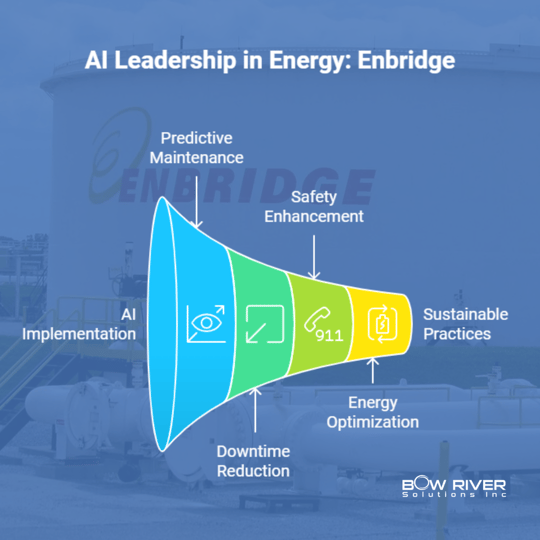
Pipeline and Equipment Monitoring – Companies like Enbridge use AI for real-time monitoring across pipelines.
AI detects anomalies and protects communities by reducing risks.
Network security in computer networks ensures safe data transfer. -
Sustainability Initiatives – AI reveals efficiency gaps and helps reduce emissions.
AI also enables custom software product development services designed for energy operations. With strong data migration methodology and secure data migration systems, companies modernize without losing reliability.
Enbridge shows how combining software development software with data privacy in cyber security improves operations and builds customer trust.
Conclusion
AI leadership is not about following trends.
It is about aligning AI with real business goals, delivering measurable ROI, and building long-term strength.
Key takeaways include:
-
Start with clear, high-value use cases.
-
Invest in scalable infrastructure, including cloud services and data migration systems.
-
Prioritize security with strong data privacy in cyber security.
-
Develop talent through data analytics courses and learning analytics courses.
-
Use custom software development to tailor AI to business needs.
At brs, we help organizations turn data into insights using Business Intelligence, Data Analytics, Cloud Services, and Software Development.
Whether you're adopting different BI tools, modernizing with a data migration system, or building custom software applications, our experts help unlock AI’s full potential.
Ready to explore how AI can transform your business?
Contact us at info@bowriversolutions.com