%20Logo.png?width=100&height=100&name=brs%20(Bow%20River%20Solutions)%20Logo.png)
 By
·
4 minute read
By
·
4 minute read
In a world increasingly driven by data, competitive advantage comes from turning information into action—reliably, repeatably, and at scale.
Whether you operate in Energy, Manufacturing, Agriculture, or Technology, better decisions start with the right Data Solutions and a clear understanding of the four core analytics disciplines: descriptive, diagnostic, predictive, and prescriptive analytics.
When combined with sound Data Management, robust Data Security aligned to Zero Trust, and modern Cloud Services, these capabilities power a durable corporate data strategy.
This guide explains each analytics type, how they work together, and a practical road map to build analytics maturity.
Along the way, we connect the dots to enablers like Business Intelligence (BI), AI applications, Custom Software Development, Cloud & Tenant Migration, and Data Training so your teams have the tools—and the skills—to execute.
Descriptive Analytics: What Happened?
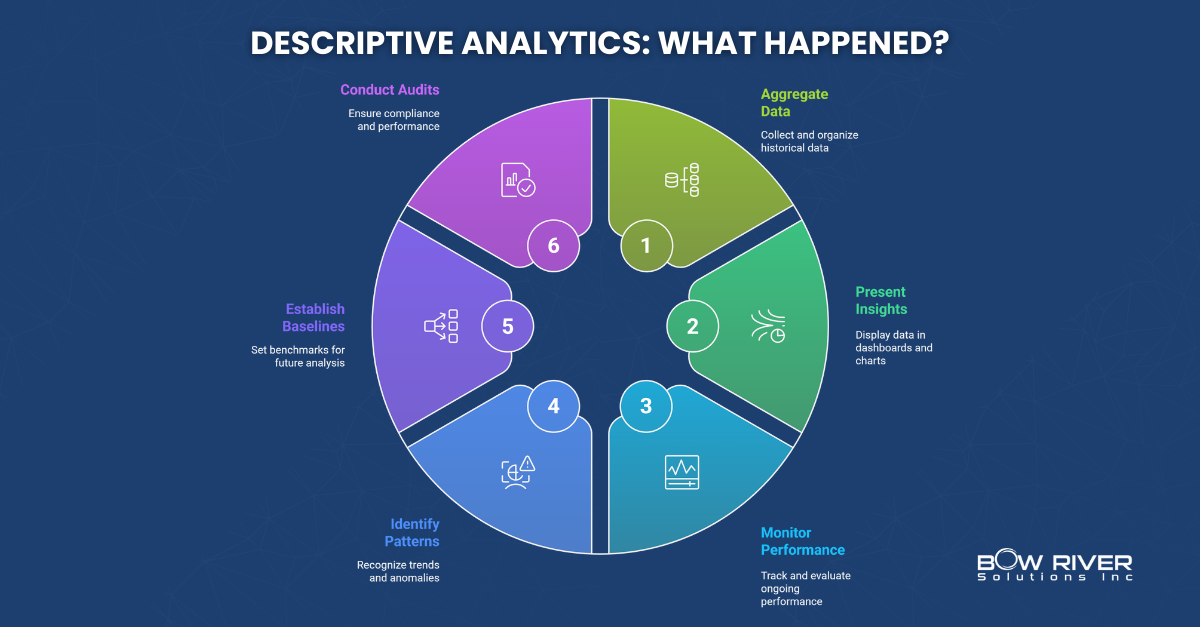
Descriptive analytics is the bedrock of decision-making.
It aggregates historical data and presents it through dashboards, reports, and KPIs so teams can see performance at a glance.
What it delivers
-
Clear visibility into trends, variances, and baselines.
-
Common, trusted metrics for operations, finance, HSE, supply chain, and more.
-
Fast answers to routine questions without ad-hoc data hunts.
Typical stack
-
Business Intelligence applications such as Power BI.
-
SQL warehouses and data lakes on the cloud.
-
Data models that standardize definitions across the business.
Use cases
-
An energy operator tracks monthly production, downtime, and emissions against plan.
-
A manufacturer monitors OEE and scrap by line, shift, and SKU.
-
Retail teams follow web traffic, conversion funnels, and average order value.
Descriptive analytics also supports compliance and audits.
Reliable computer and network security plus robust access controls keep reporting environments aligned with data privacy and data protection expectations.
At brs (Bow River Solutions), we often deploy business intelligence as a service to accelerate time-to-value while we co-develop internal capabilities.
Diagnostic Analytics: Why Did It Happen?
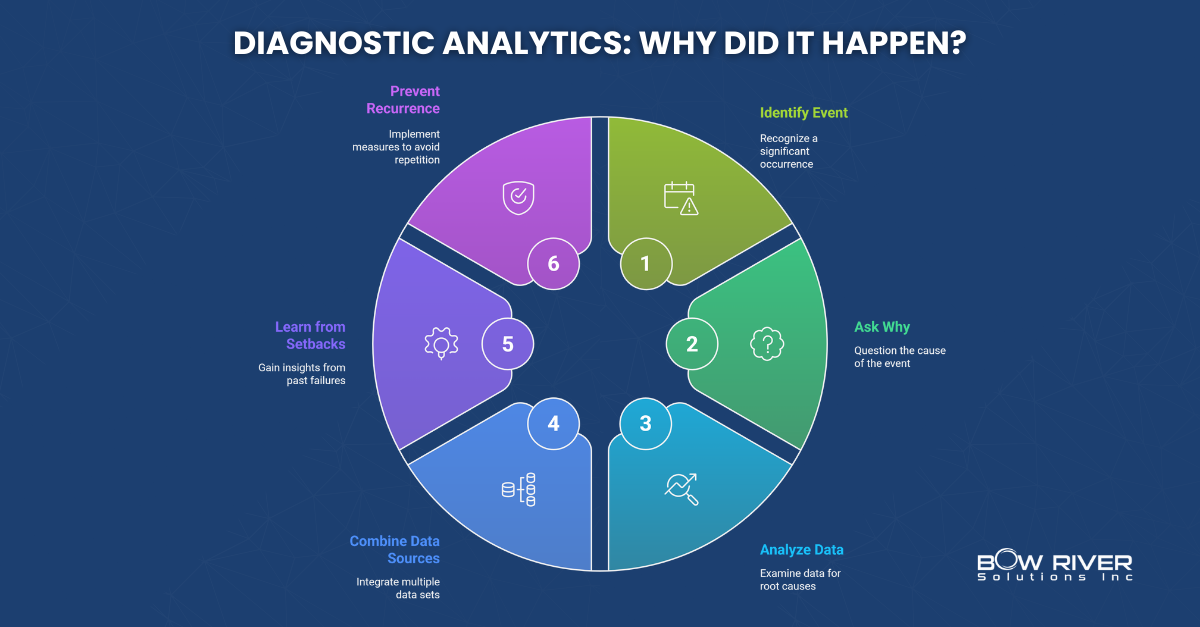
Once your teams agree on the facts, the next step is understanding causality.
Diagnostic analytics explores relationships within your data to explain anomalies and performance shifts.
Techniques
-
Drill-downs and decomposition trees.
-
Correlation and cohort analysis.
-
Data mining across multiple sources (ERP, historians, EAM/CMMS, CRM).
Use cases
-
A pipeline operator explains a throughput dip by linking it to maintenance timing and ambient temperature.
-
A tech firm ties a spike in support tickets to a feature change and a specific device OS.
-
An agricultural producer traces yield variance to irrigation intervals and soil characteristics.
Diagnostic analytics thrives on data quality, master data, and governed semantic models.
That means investing in Data Management, well-documented data migration methodology during platform changes, and secure integration patterns.
To protect sensitive operational data, teams should pair analysis with data cyber security measures—covering network security, segmentation, and identity controls.
Predictive Analytics: What Is Likely to Happen?
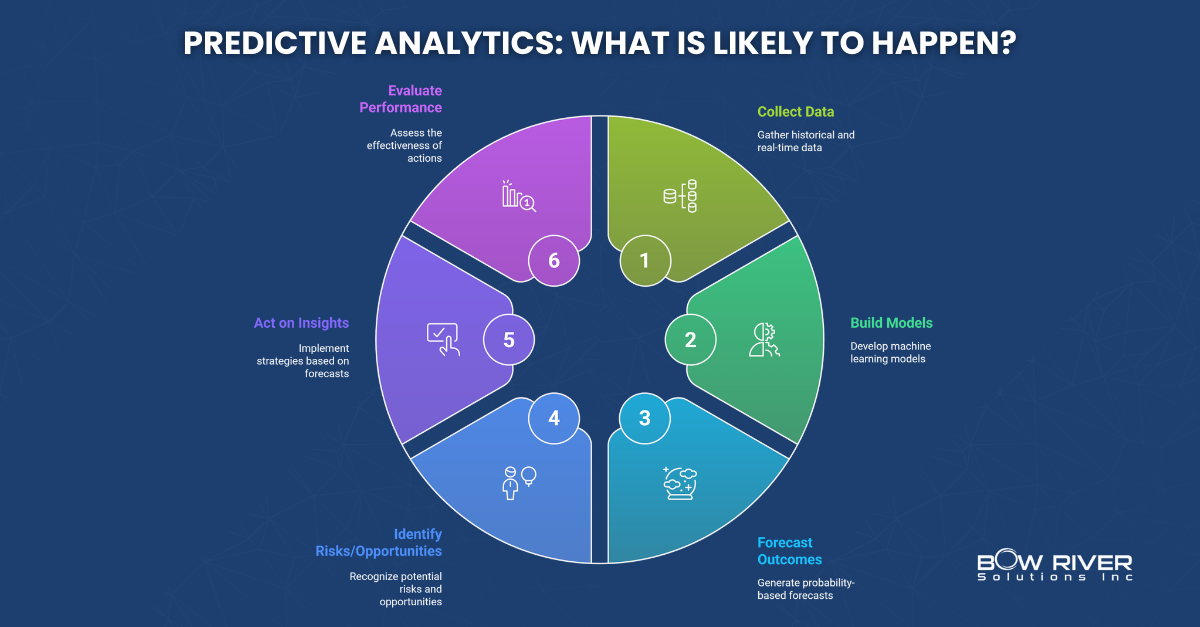
Predictive analytics looks forward, using historical patterns and machine learning to forecast outcomes and risks.
Techniques
-
Regression and classification models.
-
Time-series forecasting.
-
Gradient boosting, random forests, and neural networks.
Use cases
-
A clean-energy company forecasts wind or solar generation.
-
A manufacturer predicts asset failure using sensor data.
-
A financial services team forecasts churn to target retention offers.
Operationalizing predictions
-
Build a modular data migration system and MLOps processes for robust model deployment.
-
Stream predictions into BI tools for big data or different BI tools your teams already trust.
-
Validate models against business reality, then close the loop with measured ROI.
From a risk perspective, privacy in cyber security is critical when predictions use sensitive attributes.
At brs, we recommend a Zero Trust posture—verify identity and context continuously, encrypt data at rest and in motion, and apply policy-based access to models and features.
Prescriptive Analytics: What Should We Do?
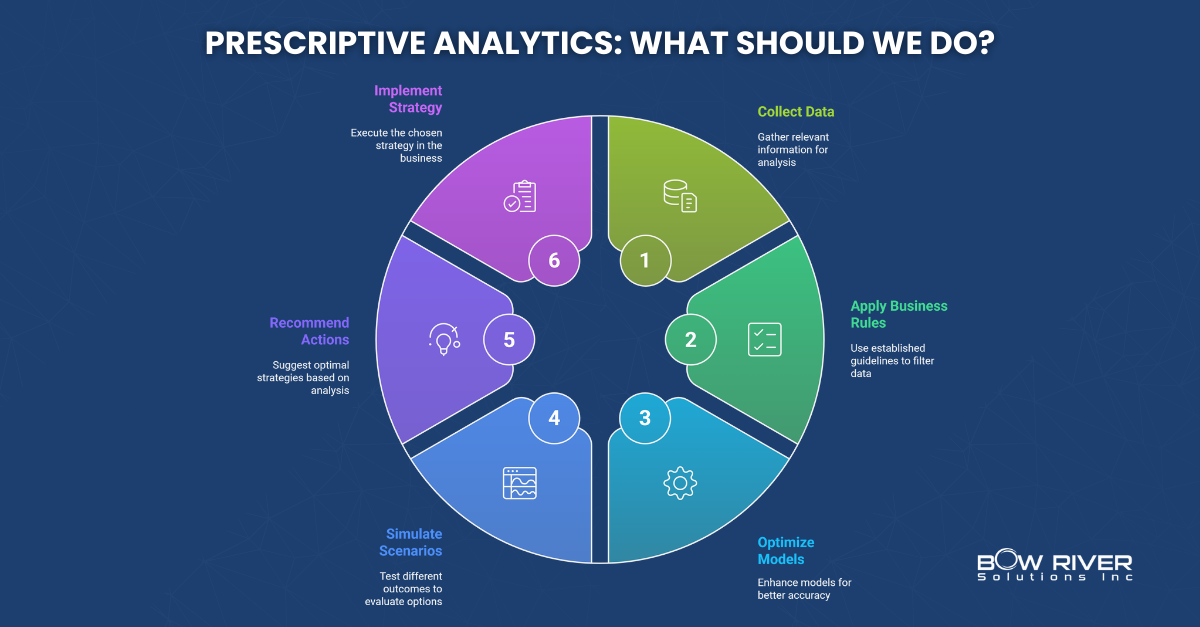
Prescriptive analytics translates predictions into recommended actions.
It optimizes for constraints like cost, time, safety, or throughput.
Techniques
-
Optimization (linear, integer, and mixed-integer programming).
-
Simulation and scenario analysis.
-
Digital twins.
Use cases
-
Logistics chooses the lowest-cost delivery routes.
-
Oil & Gas planners select an optimal maintenance windows.
-
Hospitals schedule staff to meet demand while minimizing overtime.
Prescriptive analytics work best when integrated with Software Solutions.
brs often builds custom components or integrates prescriptive engines into software stacks your teams already use.
Where needed, custom development creates the glue that makes optimization outputs actionable.
How the Four Analytics Types Work Together
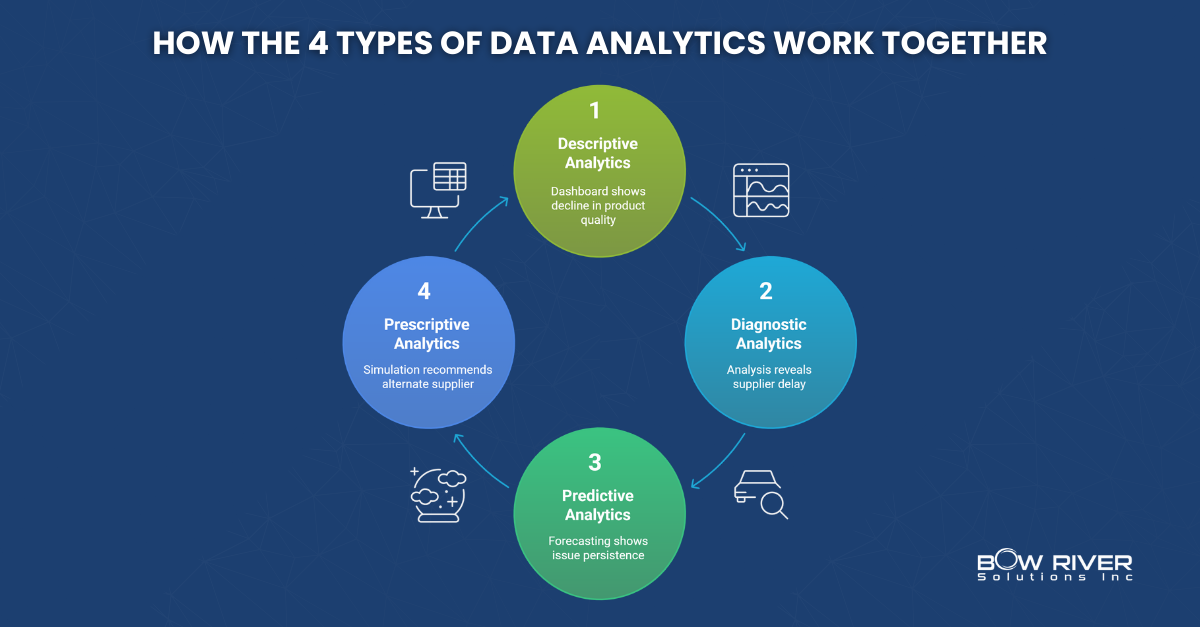
High-performing organizations treat analytics as a continuum:
-
Descriptive reveals a decline in product quality.
-
Diagnostic ties the decline to a supplier change and humidity levels.
-
Predictive warns that quality will continue to slip under current conditions.
-
Prescriptive recommends alternate suppliers and adjusted drying times.
Practical integration tips
-
Standardize models so KPIs and dimensions align.
-
Choose BI platforms that surface predictions where people work.
-
Use Cloud Services to scale compute.
-
Secure the full flow with cyber safety layers:
-
Network security, IDS/IPS, Zero Trust gateways.
-
Encryption and key management.
-
IAM with least-privilege access.
-
Continuous monitoring for cyber posture.
-
Building Analytics Maturity: People, Process, Platform, Protection
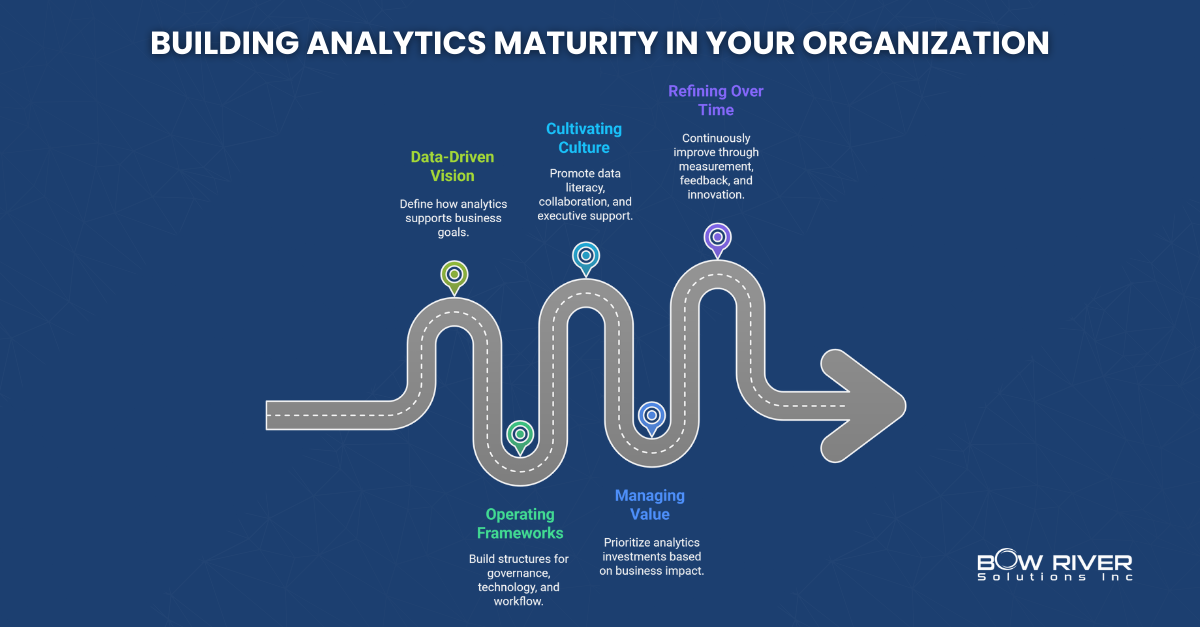
Analytics maturity is not just tech—it’s operating model.
We guide clients through five streams.
1. People (Skills & Adoption)
- Upskilling: Enroll employees in top data analytics courses, visualization certificates, or advanced tracks like a Power BI developer course.
-
Professional Development: Provide beginner certifications and applied data analytics training.
-
Accessibility: Guide teams on course fees and local or online learning options.
2. Process (Governance & Lifecycle)
-
Define corporate data strategy, ownership, and change control.
-
Establish model review boards, drift monitoring, and ROI tracking.
-
Document data migration methodology for platform changes.
3. Platform (Cloud & Integration)
-
Modernize on the cloud with secure Cloud & Tenant Migration.
-
Integrate warehouse/lakehouse with streaming and ML tooling.
-
Standardize business intelligence applications across departments.
4. Protection (Zero Trust Security)
-
Enforce cyber security and data protection with continuous verification.
-
Apply data privacy in cyber security controls to sensitive datasets.
-
Layer computer and network security with network security in cyber security practices.
-
Maintain auditability for data privacy and data protection regulations.
5. Acceleration (Software & AI)
-
Build light software development custom components to close workflow gaps.
-
Introduce targeted AI applications where they demonstrably pay back.
-
Use a trusted software solutions company (like brs) for custom software product development services when off-the-shelf limits ROI.
Conclusion
From descriptive clarity to prescriptive action, the four analytics types form a unified system for better decisions.
Organizations in Alberta and across North America that combine analytics with strong Data Management, secure Cloud Services, and a Zero Trust security posture consistently outperform peers.
Success depends on more than models: it needs a roadmap, the right BI tools, disciplined governance, and ongoing data training.
brs helps organizations implement end-to-end Data Solutions—from BI as a service to AI-driven optimization and Custom Software Development—with security built in.
If you’re ready to translate data into outcomes, we’d love to partner with you.
Contact us at info@bowriversolutions.com to get started.